Cloud storage delivery models are divided into four types:
➡Public Cloud
➡Private Cloud
➡Hybrid Cloud
➡Community Cloud

The public cloud is the one in which cloud infrastucture services are provided to general public or large industry group over internet. In this cloud model, the infrastructure is not owned by user but by the organization which provides the cloud services.
The storage backup and retrieval services in this model are provided without any cost or as subscription or based on used basis.
Examples of Public cloud:
•Amazon elastic compute cloud (EC2)
•IBM SmartCloud Enterprise
•Google AppEngine
•Windows Azure Services Platform

The private cloud is the one in which cloud infrastructure is set aside for exclusive use by single organization. It is owned, managed and operated by organization, third party or combination of both. The cloud infrastructure in this model is provisioned on the premises of organization but hosted in data center owned by third party.
In private cloud, organizations will have advantages over public cloud as it provides greater flexibility of control over cloud resources to them. Moreover private cloud is useful in the storage applications where in security, latency and regulatory issues are of utmost concern.
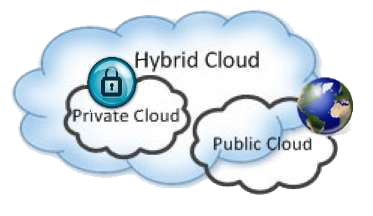
As the name suggests, hybrid cloud is the combination of other cloud models: public cloud and/or private cloud and/or community cloud. This model takes advantages of all the models which are part of it. Hence it will have scalability, cost effectiveness, and data security, all in one model. The disadvantage of this model is difficulty in implementing such a storage solution.
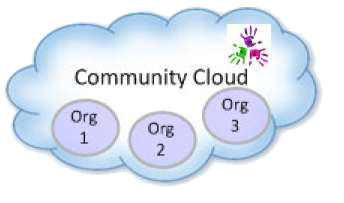
The model type community cloud shares the cloud infrastructure across several organizations to support specific community having common concerns. In this model, cloud infrastructure is provided on the premises or at the data center owned by third party. This is managed by participating organizations or third party.
Community cloud takes benefits of both public cloud (e.g. minimal shared infrastructure costs, pay per use basis billing) as well as private cloud (e.g. added privacy level, policy compliance ).
Following table summarizes difference between public cloud, private cloud, hybrid cloud and community cloud types.